
Collector's Guide Vol. 7 — Small Marvels on the Palm: Collecting Japanese Kōgō (Incense Containers) Across Nabeshima, Kyō-yaki, and Mashiko
Updated: 4d
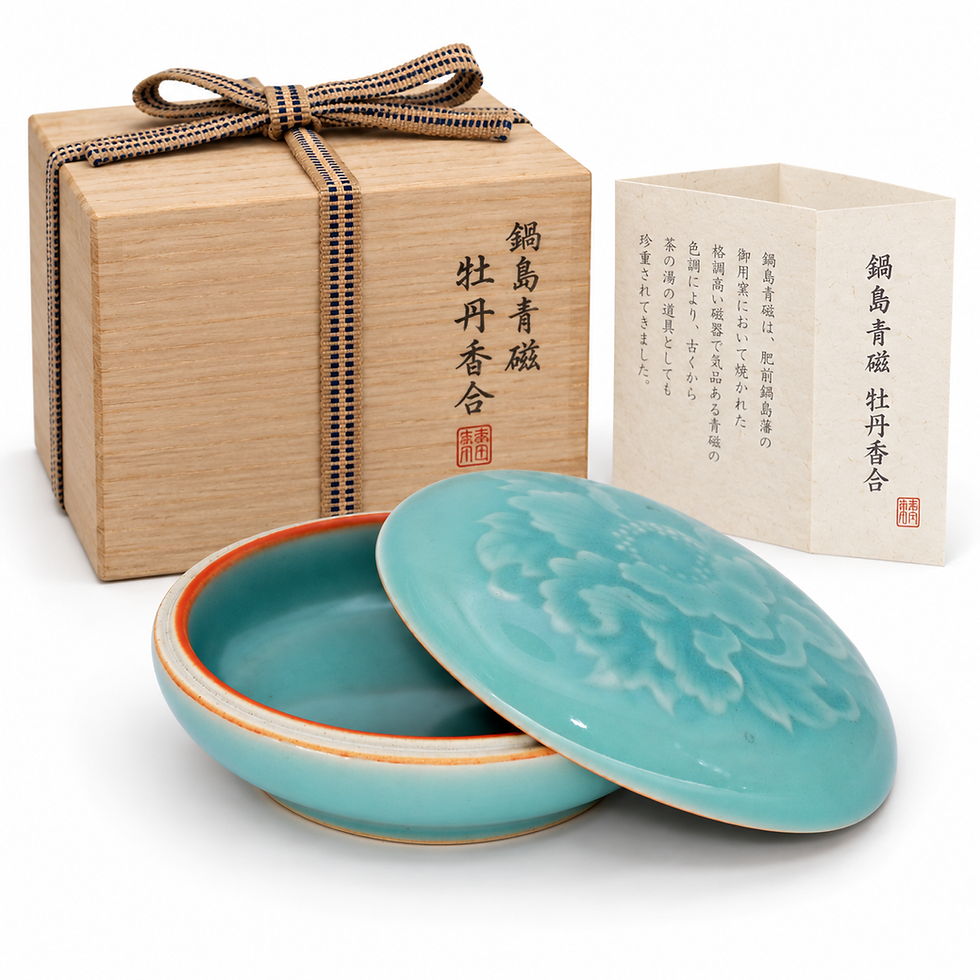

In the hierarchy of the Japanese tea room (chashitsu), size and artistic rank operate in inverse proportion. Few objects illustrate this more clearly than the kōgō (香合)—the small lidded incense container displayed in the tokonoma alcove during a formal tea gathering and opened beside the hearth to replenish aromatic wood or kneaded incense pellets (nerikō). Measuring between four and seven centimeters across, a kōgō invites guests to lean in closely, cradle the vessel in the palm, and inspect the precision of the lid seal (ai-guchi 合口), the interior finish, and the signed paulownia box (tomobako 共箱) that accompanies it.
For collectors entering or deepening a Japanese ceramic collection, kōgō offer an extraordinary advantage: because top kiln masters treat the incense box as a jewel of seasonal expression, you can compare three radically different technical lineages side by side on a single shelf or tray. Here we examine three exemplary works from Sabiru Treasures' curated collection—spanning Okawachiyama Nabeshima celadon, Kyoto overglaze polychrome and gold leaf, and Mashiko nerikomi-zōgan clay inlay.
1. Imperial Restraint in Jade: Ichikawa Wakō's Nabeshima Celadon Peony Kōgō (Lot 108006765)
During the Edo period, the Nabeshima clan's official kiln at Okawachiyama in Imari (Saga Prefecture) produced porcelain exclusively for the shogunate and feudal lords. Unlike export wares made for European palaces, Nabeshima celadon (Nabeshima seiji 鍋島青磁) prized quiet sculptural modulation achieved by grinding natural celadon glaze stone mined in Saga.
In our live curated highlight by Ichikawa Kazuhiro / Ichikawa Wakō (市川和啓・和光, b. 1945), head of Wakō Tōyō (和光陶窯) and a certified Traditional Craftsman (Dentō Kōgeishi), the circular kōgō lid is molded and hand-carved into a blooming peony (botan 牡丹). Look closely at how the translucent celadon glaze behaves across the topography of the flower: - Pooling in the Carved Valleys: Where the knife cut deeper channels between overlapping petals, the glaze gathers thicker and fires to a serene, luminous sea-jade tone. - Breaking White Along the Crests: Along the crisp petal edges, the glaze thins just enough to reveal the pure white Arita/Imari porcelain body beneath. - Documentary Completeness: Turning the base over reveals the hand-brushed underglaze cobalt mark Wakō (和光) inside a recessed footring, matched by the signed paulownia tomobako lid inscribed Seiji Kōgō / Wakō saku (青磁香合 / 和光作) and the artist's printed biography (shiori).
2. Playful Courtly Luxury in Kyoto: Kitamura Gakō's Paper Balloon (Kamifūsen) Kōgō (Lot 108007244)
If Nabeshima celadon whispers through monochrome relief, Kyō-yaki / Kiyomizu ware (京焼・清水焼) delights in theatrical poise and seasonal wit. In Kyoto tea gatherings, a kōgō often introduces a playful visual pun (mitate) that softens the formality of the ceremony.
Kitamura Gakō (北村雅耕) shapes this spherical incense container as a nostalgic Japanese paper balloon (kamifūsen 紙風船). On the exterior, alternating curved panels of overglaze red, emerald green, cobalt blue, and warm yellow enamel (iroe 色絵) mimic the pleated translucent paper segments of a childhood toy, complete with a simulated air-hole opening at the crown. Yet when the collector lifts the lid, the interior reveals a breathtaking surprise: flakes of pure gold leaf (kinpaku 金箔) scattered across the pale cream-glazed well like autumn light on water. The unglazed buff Kyoto clay base bears Gakō's oval impressed potter's mark, while the paulownia tomobako lid is brushed in three balanced columns: Kamifūsen / Kōgō / Gakō-zō (紙風船 / 香合 / 雅耕造).
3. Structural Woodland Poetry: Saeki Morimi's Nerikomi-Zōgan Forest Kōgō
Moving northeast from Kyoto to Tochigi Prefecture (Mashiko and Utsunomiya), we encounter one of contemporary Japan's most technically demanding ceramic processes in the work of Saeki Morimi (佐伯守美, b. 1949)—a graduate of Tokyo University of the Arts (where he studied under Living National Treasure Tamura Kōichi and Fujimoto Yoshimichi) and recipient of the prestigious Japan Ceramic Society Award.
Rather than painting trees onto a fired glaze, Saeki constructs his winter birch and woodland scenes inside the clay wall itself through a synthesis of nerikomi (練込, laminating colored clays) and zōgan (象嵌, inlaying colored slips into carved grooves), veiled under a soft wood-ash glaze. When you rotate Saeki's lidded container, the vertical tree trunks pass seamlessly across the horizontal join between lid and body—requiring exact calculation of clay shrinkage during drying and high-temperature firing.
What to Check When Acquiring a Japanese Kōgō
The Lid Seating (Ai-guchi 合口): Gently lift and replace the lid. On a finely potted kōgō, the unglazed inner flange sits level without wobbling, and on figurative or patterned works (like Saeki's forest or Gakō's paper balloon panels), the design aligns at a single intended orientation (shōmen 正面).
Interior Condition & Gold/Glaze Integrity: Because kōgō are opened during tea gatherings, ceramicists lavish attention on the inside of the lid and lower well. Never scrub interior gold leaf (kinpaku); dust only with a soft dry brush.
Tomobako & Shiori Documentation: Keep the signed paulownia box, stamped cloth, and shiori biography together as a permanent archival record.
Download Our Free Collector's Handbook & Explore the VIP Archive
Want a printable desk guide to reading tomobako inscriptions, potter's seals, and material care alongside 20 curated highlights? Download our complimentary Sabiru Collector's Handbook & Curated Highlights (PDF) or share your 3-Question Collector's Preference Profile at Collector's Inquiry to request private access to our closed VIP Archive Lookbooks (Vol. 1 & Vol. 2).


Comments