.png)
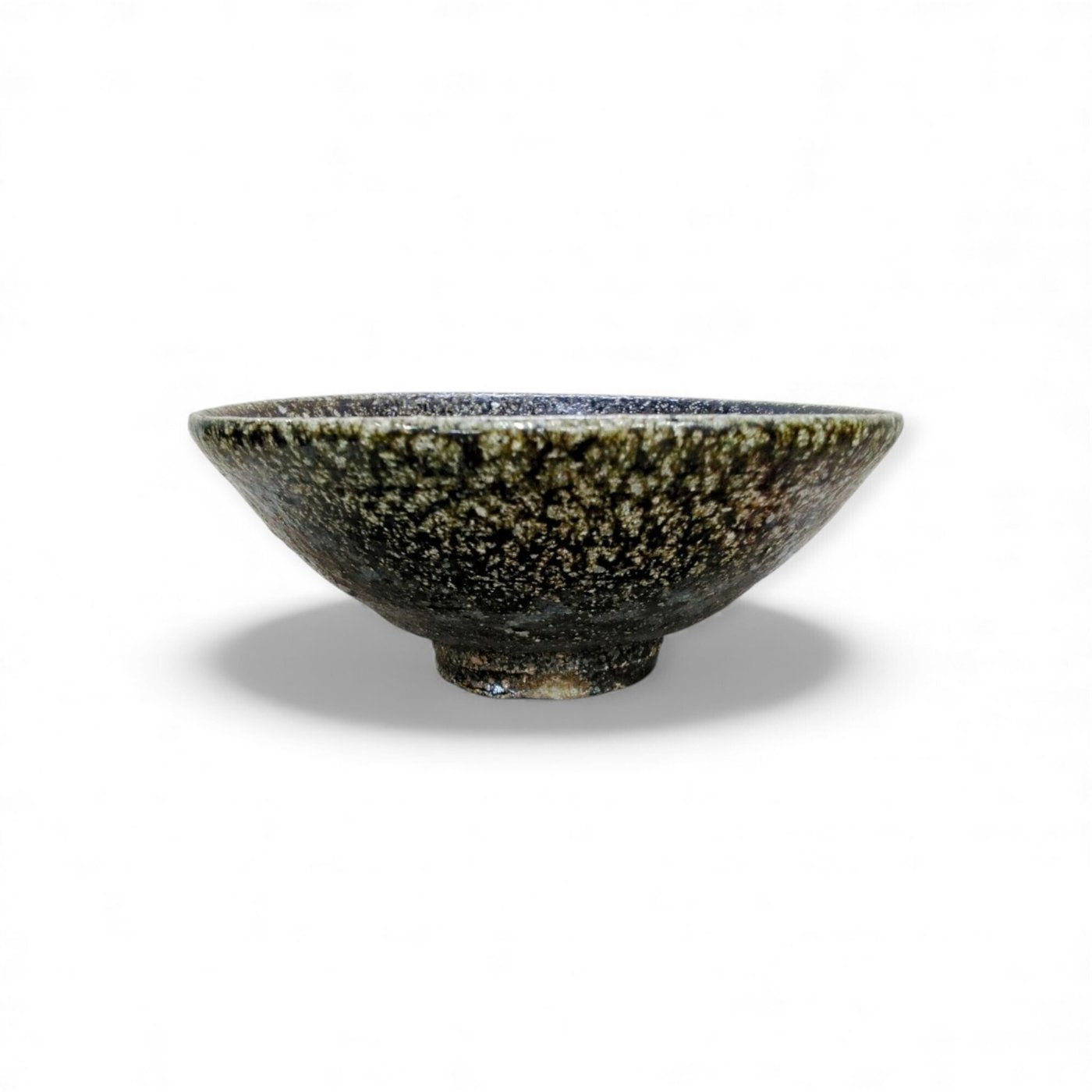

15cmx6.5cm
Work of Yamamoto Senzan (born Taishō 5/1916), student of Living National Treasure Ezaki Issei – Tokoname stoneware with natural ash glazing in the ko-Tokoname tradition – Unused since acquisition during the Shōwa era, retaining original kiln-fresh characterSummary: Tokoname ware holds a particular position in Japanese ceramic history – it represents one of Japan's oldest continuous pottery traditions, with kilns operating since the Heian period. Yamamoto Senzan, working from his Jizō Kiln during the mid-to-late twentieth century, pursued the demanding technique of natural ash glazing, allowing kiln atmosphere and wood-ash deposit to create surfaces that cannot be replicated through conventional glazing methods. As a student of Ezaki Issei (designated Living National Treasure in 1955), Senzan inherited direct lineage from one of Japan's most respected ceramic masters. This tea bowl, acquired during the Shōwa era and never used, offers collectors access to serious Tokoname pottery at a level where craft approaches fine art.
Tokoname, located on the Chita Peninsula south of Nagoya, ranks among Japan's Six Ancient Kilns – those ceramic centres whose production extends back to medieval times. Whilst Tokoname became famous for red-clay teapots during the Edo period, potters like Ezaki Issei and his students revived earlier traditions, particularly the natural ash glazing that characterised ancient Tokoname ware. These revival efforts during the twentieth century represented more than nostalgia; they embodied serious archaeological and technical research into methods largely abandoned during Japan's industrialisation.
Yamamoto Senzan studied under Ezaki Issei during the post-war decades when Japanese ceramics experienced a renaissance. Issei, designated Living National Treasure (formally "Holder of Important Intangible Cultural Property") in 1955, specialised in ash-glazed Tokoname stoneware that revived medieval techniques. His teaching emphasised patient observation of how ash deposits naturally during wood-firing, how flame path affects glaze development, and how clay body and firing atmosphere must work in concert. Senzan absorbed these lessons, establishing his Jizō Kiln to continue this demanding tradition.
Natural ash glazing – called "shizen-yū" in Japanese – occurs when wood ash from the kiln's fuel settles on clay surfaces during high-temperature firing. The ash melts, fusing with the clay body to create glazes ranging from subtle earth tones to dramatic runs and pooling. Potters cannot fully control the results; they can only manipulate kiln construction, firing duration, and ash distribution to influence outcomes. This element of calculated chance appeals to collectors who value wabi-sabi aesthetics, where imperfection and unpredictability become virtues rather than flaws.
This tea bowl demonstrates the technique's subtle beauty. The ash glaze produces muted earth tones – likely variations of grey, brown, and olive depending on local ash chemistry and firing temperature. The surface texture carries the slight irregularity that distinguishes wood-fired work from industrial ceramics. For tea ceremony practitioners and collectors of Japanese pottery, these qualities represent authenticity – the honest expression of materials and process that defines serious ceramic art versus decorative production.
The bowl's unused condition adds another dimension to its appeal. Acquired during the Shōwa era (1926–1989) and preserved carefully since, it retains the character it possessed when first drawn from the kiln. No tea staining, no hairline cracks from thermal shock, no handling wear – simply a ceramic object suspended in time, awaiting the collector who will either preserve its pristine state or finally employ it as originally intended. Either approach honours the potter's work; what matters is recognising the piece's connection to a living ceramic tradition that continues valuing hand-crafted objects in an increasingly mass-produced world.
